Volume 1
jack is one of the key powers of our age, and his essay From Hierarchy to Intelligence adds to the canon of organizational strategy in a meaningful way.
Block is an edge case, but jack serves up his framework as a doctrine, wrapped inside intellectually tasty historical context.
jack’s model is elegant, but sociology is pretty clear that humans don’t behave like rational actors, even with complete context. They behave like humans.
His world model can tell you that merchant churn is up 12% in a segment. It can’t tell you that the DRI who owns that problem is quietly resentful of the player-coach who keeps second-guessing her, and that tension is why two capability teams aren’t actually collaborating even though the model says they’re aligned.
Still, Block is a technically sophisticated and united workforce with a highly machine-readable business.
It’s low complexity and low velocity, a couple ingredients that warp alignment. In other words, it’s a low relational need system.
jack’s a brilliant systems thinker, and he’s built a system optimized for his org’s specific information environment.
Surely jack knows Block is an edge case, which makes the military history and universality a choice, not an oversight.
Leadership thinking has always done this, and jack’s only doing what he’s programmed to do.
He turned an email into a meeting, if you know what I mean.
Now the room is fighting over right or wrong, missing the actual question: what does your system look like when you close your eyes and see it whole?
Here’s how to do that.
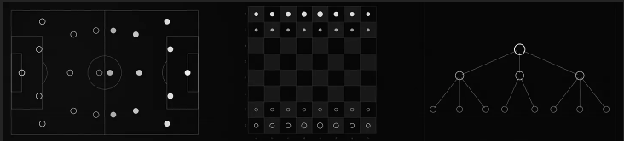
These charts are static, but the game isn’t.
Let’s run a thought experiment using our mind’s eye. Stay with me now.
Start with a 3D cube — use your mind’s eye to imagine looking at a 3D cube from the outside.
You can place nodes inside your 3D cube, like they are soccer players. The players group amongst themselves into cylinders, like teams… finance, data, engineering, science, strategy, creative, or whatever is inside your org.
All nodes can wake up on the wrong side of the bed, and each cylinder has its own agenda. They’re all networked, but move independently.
Friction is woven into the very fabric of spacetime that organizations exist along.
Organizations, like soccer teams, can tell you who scored the goal, and maybe even who got the assist.
But institutions haven’t yet learned how to measure the person who scored no goals or assists but covered more surface area than anyone else – playing in the space between teams.
Team sports and chess are games of strategy, where glue is essential.
Organizations are messier than team sports and chess, which helps glue hide.
Welcome to the philosophy of glue.