Volume 2
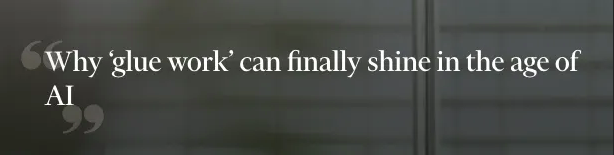
FT just published “Why ‘glue work’ can finally shine in the age of AI”, adding to the evidence that something is shifting. As someone with a Philosophy of Glue, the FT piece is validation, and the timing is natural.
But I’m an observer by nature. I live upstream of FT, and I’m more curious by the “why” behind FT’s “what.” AI is a powerful accelerant, shifting the balance further in wicked’s favor. What the fuck am I talking about?
We live in a world our institutions were not designed for. They were modeled for a kind environment, but ours is wicked.
In kind environments, you can measure performance by outputs because inputs are predictable and stable. Organizations weren’t ignoring glue work. They were just designed to see a different kind of work.
Wicked describes environments of high complexity and velocity. What Hogarth observed in learning, what Epstein named in development, and what Rittel argued for in public planning shows up everywhere humans organize.
Wicked is universal. It rises and falls as society moves through time.
Wickedness rising changes what’s load-bearing inside a system. Complexity and velocity make outputs less meaningful than the invisible work holding the system together.
The internet was the first major catalyst pulling us out of post-war equilibrium. AI is a powerful accelerant, pushing the balance further in wicked’s favor.
Organizations, like soccer teams, can tell you who scored the goal, but institutions haven’t yet learned how to measure the person who scored no goals or assists but covered more surface area than anyone else – playing in the space between teams.
Glue work is becoming visible because wicked systems make it load-bearing, and AI made it impossible to look away.
I wrote about this last year in Designing Human Systems in a Wicked World.
The Great Glue Wars aren’t starting. They’ve been running since the internet broke the kind-world model.